Bathroom Open Cabinet Design Tips for a Cozy, Modern Look
Live edge bathroom vanity ideas: what it is, which styles suit small baths, how to pick wood and finish, and how to keep the slab looking good.

By Julio Arco
Architect and online interior designer
In this post
- What makes a live edge vanity different?
- Which vanity styles work best?
- Small live edge bathroom vanity ideas
- How do you choose the wood?
- What finish protects a live edge bathroom vanity top?
- Installation tips
- How do you style a rustic live edge bathroom vanity so it…
- Daily care and maintenance
- Frequently asked questions
A live edge bathroom vanity is a vanity whose top is a wood slab that keeps the tree's natural outer edge instead of a sawn, straight one. It works best when the slab is the one organic element in the room, sealed well against water, and paired with simple lines and open space around it.
If you want a bathroom that feels warm without looking like a cabin, this is one of the easier ways to get there. Below: styles, wood choices, finishes, installation and upkeep.
What makes a live edge vanity different?
A standard vanity top is cut, milled and finished to a uniform line. A live edge top leaves the curve, bark line or irregular contour of the slab as it grew. No two are alike, so the vanity becomes the focal point of the room rather than background storage.
The trade-off is care. Wood moves with humidity, and a bathroom is the humid room of the house. A live edge top needs a proper sealed finish and a little regular attention, which a quartz or porcelain top does not.
Which vanity styles work best?
Single slab
One slab across one sink base is the cleanest way to show off the grain. It suits most powder rooms and guest baths, and it keeps the look calm. Let the natural edge face the room, not the wall, so people actually see it.
Floating live edge vanity
A floating live edge vanity is mounted to the wall with open floor beneath. Seeing more floor makes a small room feel larger, and it makes mopping easy. Wall-hung units need solid blocking in the wall behind the finish, so have a licensed contractor confirm the framing before you commit to a heavy slab.
Live edge vanity with vessel sink
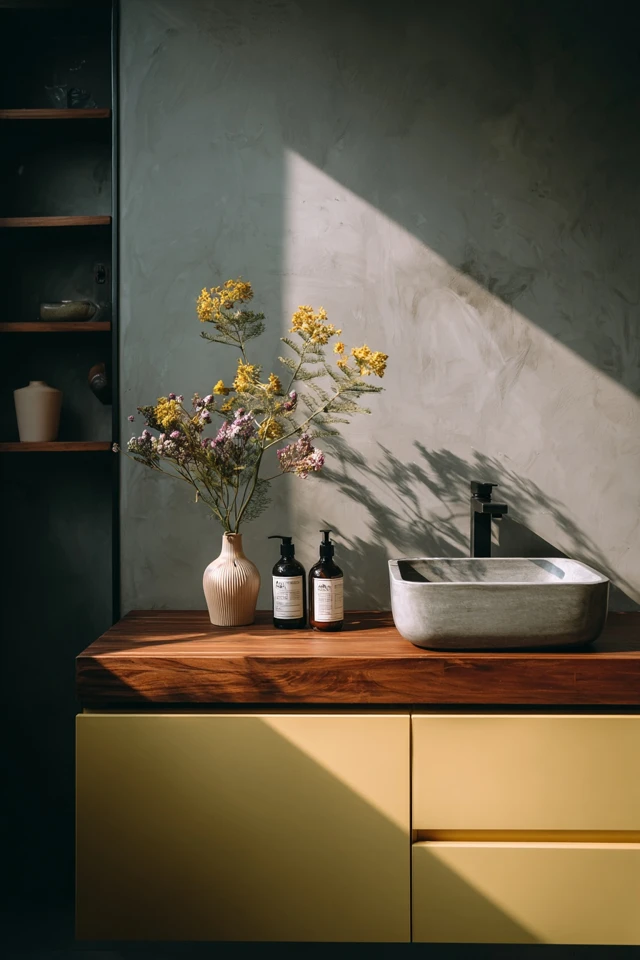
A live edge vanity with vessel sink puts the bowl on top of the slab, so the wood is mostly kept out of the wet zone beneath the basin. The catch is splash. Pair a vessel with a wall-mounted faucet, or a tall deck faucet, so water lands in the bowl and not on the grain.
Undermount or integrated sink
This gives a flatter, more modern look, but the cutout edge is the most vulnerable spot. Seal the cut edges of the opening as carefully as the top surface.
Small live edge bathroom vanity ideas
In a small bath, scale matters more than anything. A few approaches that work:
- Choose a slim slab, roughly 18-21 inches deep, so the vanity doesn't crowd the walkway.
- Float it, and keep the wall behind it plain.
- Use one wood tone in the room and keep the rest light and matte.
- Add an open shelf or a basket below for towels, which keeps the look airy. For more ideas on wall storage, see these bathroom medicine cabinet ideas.
Leave at least about 30 inches of clear width in front of the vanity if you can, so the room doesn't feel tight.
How do you choose the wood?
Pick a dense, stable species and ask the supplier how the slab was dried. Walnut, white oak, maple and acacia are common choices for slabs. Walnut reads dark and formal, oak reads lighter and more relaxed, and acacia has high contrast in the grain. Whatever the species, a kiln-dried slab is less likely to warp or crack once it lives in a steamy room.
Look at the slab in person if you can. The edge shape, knots and color shifts are the whole point, and photos rarely show them well.
What finish protects a live edge bathroom vanity top?
You have two broad routes. A film finish, such as a marine-grade or bathroom-rated polyurethane, forms a waterproof layer and needs the least upkeep. An oil finish looks and feels more natural but needs to be reapplied. The same principle applies to other porous surfaces: Iowa State University Extension notes that a butcher block counter needs to be oiled regularly.
As an architect, I recommend a film finish for a bathroom used daily, especially a family bath with kids. Save oil for a powder room that sees little water. Whichever you choose, seal the underside and the back edge too, since moisture gets in where you can't see it.
Installation tips
- Let the slab acclimate in the house for a few days before it is cut and sealed.
- Seal every cut, including the faucet and drain holes.
- Leave a small gap or a flexible silicone bead where the slab meets a wet wall, so seasonal movement doesn't crack the joint.
- Use a licensed plumber and carpenter for wall-hung or heavy units.
If you'd rather not build around a full vanity, a live edge countertop for bathroom use can also sit on a simple painted cabinet base. That gives you the slab without the custom cabinetry.
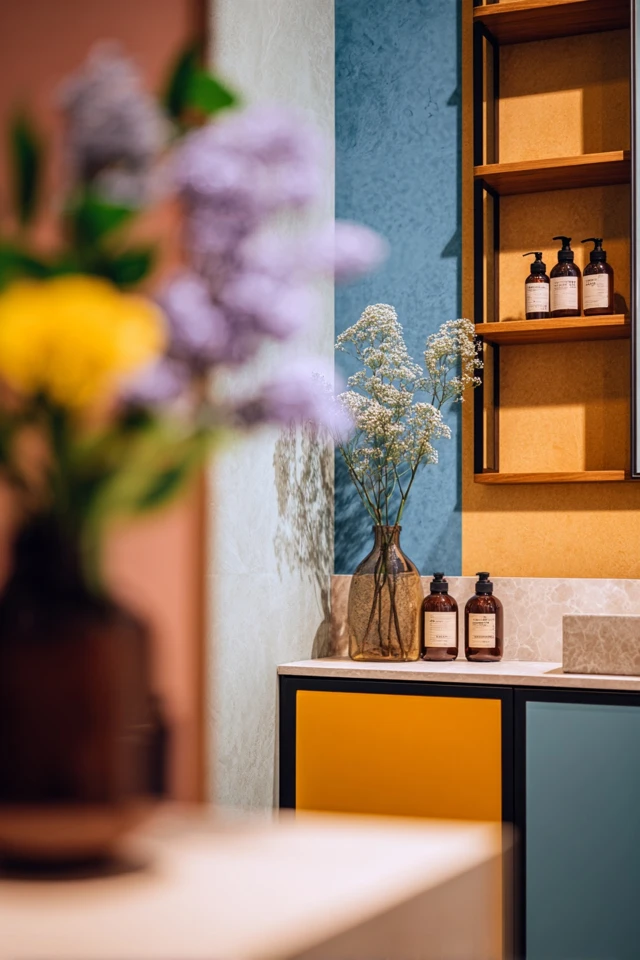
How do you style a rustic live edge bathroom vanity so it feels modern?
A rustic live edge bathroom vanity tips into cabin territory when everything around it is also rough. Keep the rest quiet: plain tile, a simple round or rectangular mirror, and matte black or brushed brass hardware. Pick one or two materials beyond the wood, and let the slab do the talking.
Warm bulbs around the mirror bring out the grain. A couple of woven baskets and a plant add texture, and a pet-safe plant is the smart pick if a dog or cat shares the bathroom (check with your vet if you're unsure about a species).
Daily care and maintenance
- Wipe standing water off the top, especially around the sink.
- Clean with a soft cloth and mild soap, not abrasive cleaners.
- Use a small tray for toothbrush cups and soap so wet items don't sit on the wood.
- Run the exhaust fan during and after showers.
- Check the finish once or twice a year and touch up any dull or worn spots early.
If you want more ideas for finishing the rest of the room, our minimalist entryway post shows how the same restrained approach works for a different space.
Frequently asked questions
Are live edge vanities a good idea in a bathroom?
Yes, if the slab is dried properly and sealed on every side. Humidity is the main risk, so a durable finish and a working exhaust fan matter more than the species.
What is the best wood for a live edge bathroom vanity?
Walnut, white oak, maple and acacia are common because they are dense and stable. Ask for kiln-dried slabs to reduce warping.
Can you use a live edge slab with a vessel sink?
Yes. The bowl sits on top, which keeps the wood away from the wettest area, but use a tall or wall-mounted faucet to limit splashing on the grain.
How do you keep a live edge vanity top from warping?
Start with a kiln-dried slab, seal all sides including the underside, and keep humidity down with a vent fan. Wipe standing water promptly.
Filed under
ArticlesMeet the author
Written by an architect.
Julio Arco is a passionate architect with years of experience in architecture, interior design, urban design, and housing. He studied at prestigious universities across North America and Europe.

- Name
- Julio Arco
- Job
- Architect and online interior designer
- Studied
- Architecture, ITESM · Urban Design and Housing, McGill
- Partner
- Thor, Australian Shepherd
- Thor’s title
- Head of quality control