The Best Home Office Designs Trends to Try This Year
Home office shelving ideas for small rooms, walls and DIY builds, plus how to style shelves so they hold files and still look good.

By Julio Arco
Architect and online interior designer
In this post
The best home office shelving puts what you use daily within easy reach, moves the rest up the wall, and hides paper behind doors or boxes. Start with the wall behind or beside your desk, since that is where shelves earn their keep.
Below are the ideas I'd try first, from small-room fixes to DIY builds, plus a few rules for making the shelves look good once they're full.
Which shelving ideas work best in a small home office?
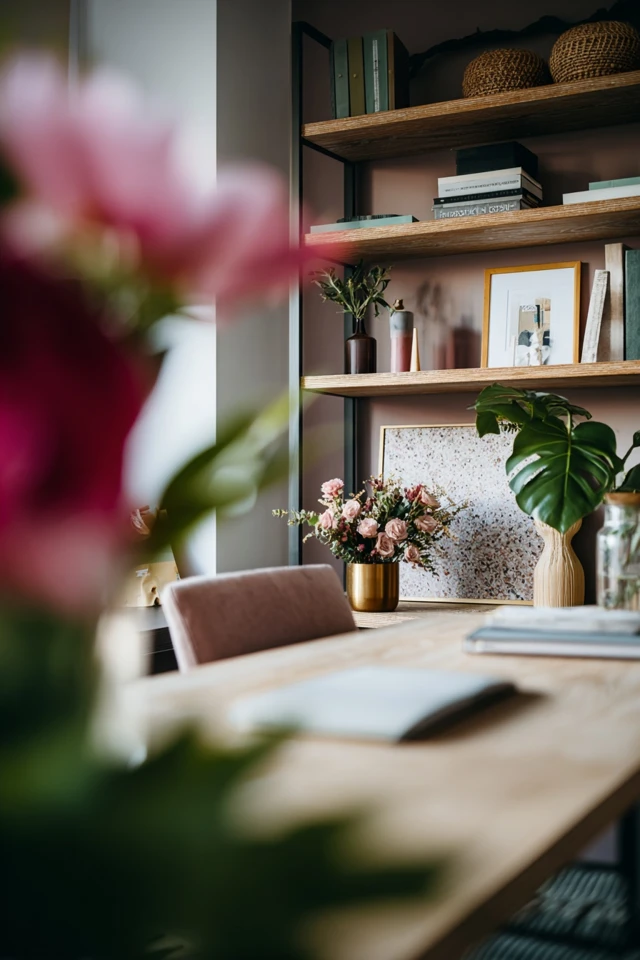
Small home office shelving ideas share one move: go vertical. Floor space is limited, wall space usually isn't.
- Hang two or three floating shelves above the desk, spaced about 10-14 inches apart so books and binders fit.
- Choose a narrow bookcase, about 10-12 inches deep, instead of a standard deep one. It leaves more room for your chair.
- Use a shelf above a doorway for rarely used binders or archive boxes.
- Carve out a closet office: remove the doors, fit a desk-height shelf, and stack shelves above it.
Keep a clear walkway of about 30-36 inches, even in a tight room. Shelves that make you turn sideways stop being helpful.
How do you use wall shelves around the desk?
Home office wall shelves behind the desk are handy, and they also frame video calls. Mount them so nothing hangs where your head will be. If a shelf sits beside the monitor, keep the screen itself clear: OSHA's computer workstation guidance says the top of the monitor should be at or just below eye level, so don't stack shelves in a way that forces you to raise it.
Anchor every shelf into studs or use rated wall anchors, especially for books and files, which are heavier than they look. If you're unsure about your wall type, ask a licensed contractor. And if you share the room with a dog, keep heavy items off low shelves a wagging tail can reach.
Where do files and paper go?
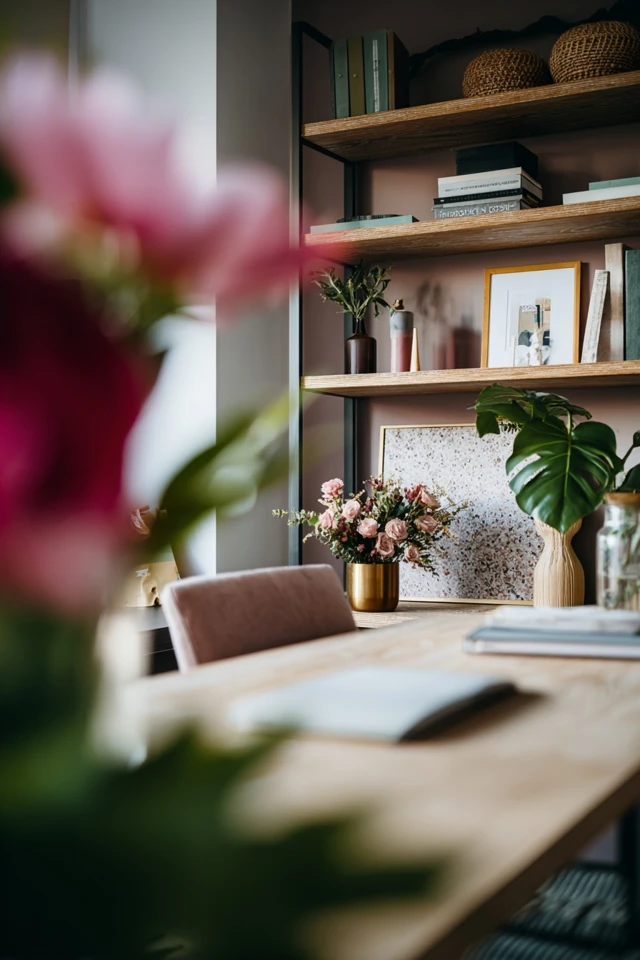
Office shelves for files work best when paper is closed away. Open shelves with labeled magazine files, lidded boxes or fabric bins keep documents upright and out of sight. Put current projects at arm height and archives on the top shelf.
Closed cabinets on the lower half with open shelves above is a reliable split. The cabinets take the visual noise, and the open shelves hold the things you like looking at. Cable management matters too: a basket or box on a shelf can hide a power strip, as long as it has airflow.
Is it cheaper to build or buy shelves?
It depends on the design. Simple floating shelves from a board and brackets are usually cheaper to build, and you pick the exact length. Built-in-look units with trim and cabinet doors take more tools and time, and a ready-made bookcase can come out ahead. Price a cut list at your lumber yard before deciding.
How can you fake a built-in look?
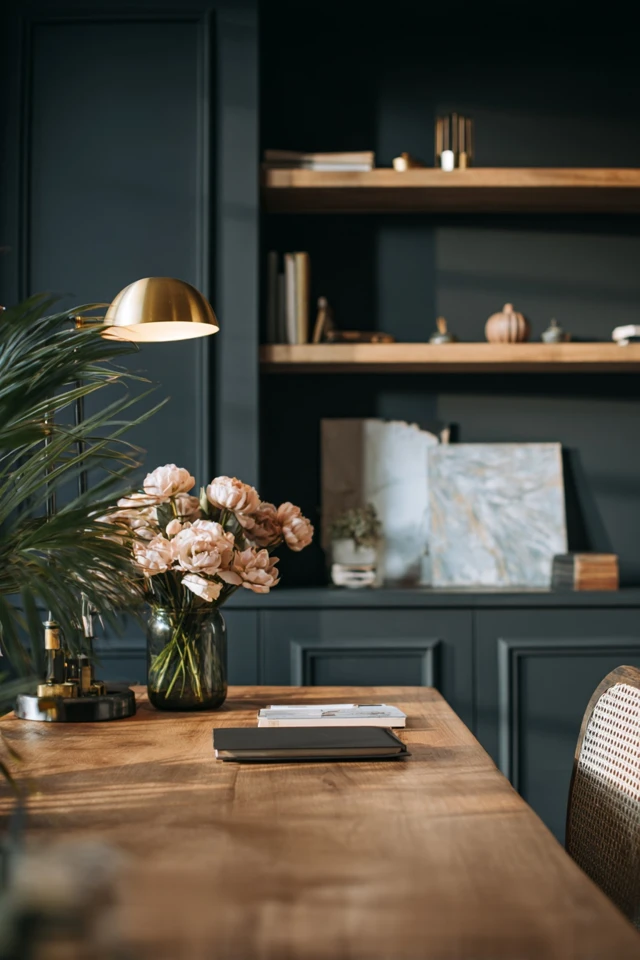
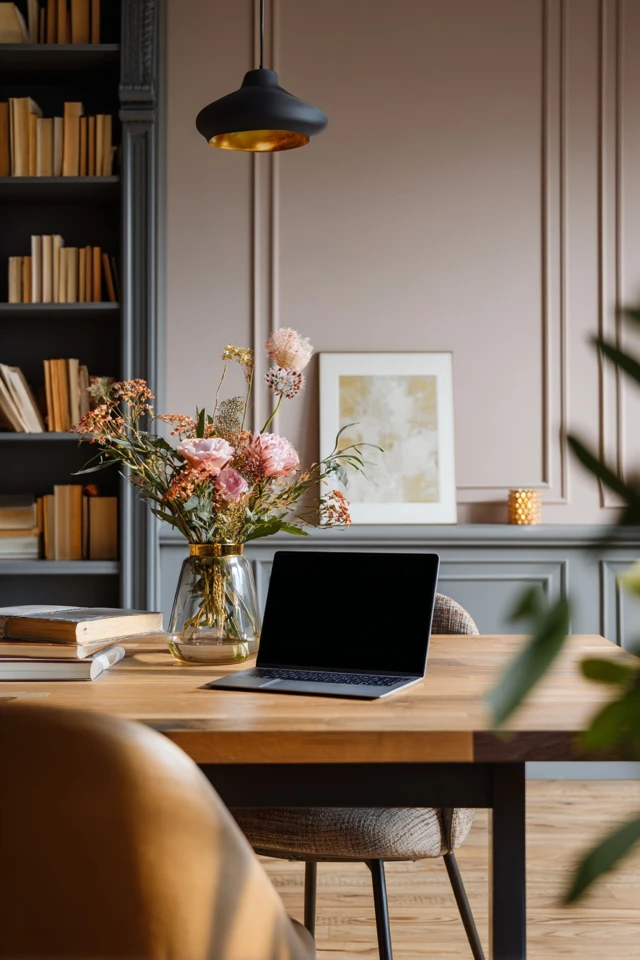
Line up two matching bookcases on either side of a window or desk, then add a shelf spanning the gap above. Paint the units the same color as the wall so they read as architecture. Fill gaps at the ceiling and sides with trim or caulk. This works well in rentals, because it uses freestanding furniture you can take with you.
How to make office shelves look nice
A few rules do most of the work:
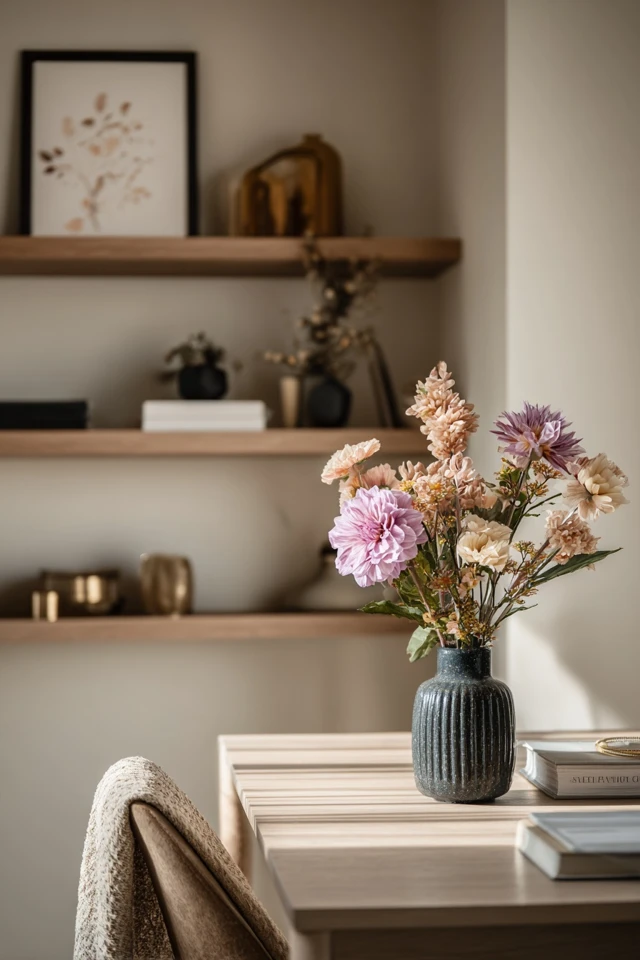
- Group objects in odd numbers. The rule of three is a useful default: one tall item, one medium, one small.
- Leave about a third of each shelf empty so it doesn't read as storage overflow.
- Mix books stacked flat and upright, a plant, and one framed piece.
- Repeat one color or material across shelves so the display feels planned.
Office shelf decor ideas that suit a workspace: trays for small supplies, matching boxes, a trailing plant on the top shelf. If you have pets, check with your vet before choosing plants, since many common ones are toxic to dogs and cats.
What are some unique shelving ideas?
Try a pegboard with small shelves you can rearrange, a ladder shelf leaning against the wall, or shelves that run corner to corner around a window. Stacking shelves to the ceiling also makes a low room feel taller, as long as you keep the top shelf for light, rarely used items.
As an architect, I'd pick one anchor idea, such as a wall of shelves behind the desk, and keep everything else simple. Mixing five styles in a small room gets busy fast. Related reading: more home office design trends and garage office ideas if your space is outside the house.
Frequently asked questions
What is the rule of three for shelves?
Group decor in clusters of three, varying height and size, such as a tall vase, a stack of books and a small box. Odd numbers tend to look more relaxed than pairs.
How deep should office shelves be?
About 10-12 inches suits books and binders. Go deeper, around 14-16 inches, only for storage boxes or equipment.
Can I use floating shelves for heavy files?
Only if they are anchored into studs and rated for the load. For full file boxes, a floor-standing bookcase is safer.
Filed under
ArticlesMeet the author
Written by an architect.
Julio Arco is a passionate architect with years of experience in architecture, interior design, urban design, and housing. He studied at prestigious universities across North America and Europe.

- Name
- Julio Arco
- Job
- Architect and online interior designer
- Studied
- Architecture, ITESM · Urban Design and Housing, McGill
- Partner
- Thor, Australian Shepherd
- Thor’s title
- Head of quality control