Your Wool Rug Like a Pro in: 8 Fixes That Get the Size Right
Find the right rug size for your dining table: the 24-inch chair rule, sizes for 4, 6 and 8 seats, round tables, and common mistakes to avoid.

By Julio Arco
Architect and online interior designer
In this post
- How big should a rug be under a dining table?
- How do you measure for a dining room rug?
- Rug size by number of seats
- Will a 5x7 rug fit under a dining table?
- What is the right rug size for a round dining table?
- Common mistakes
- What material and pile work best under a dining table?
- Open plans and layered rugs
- Frequently asked questions
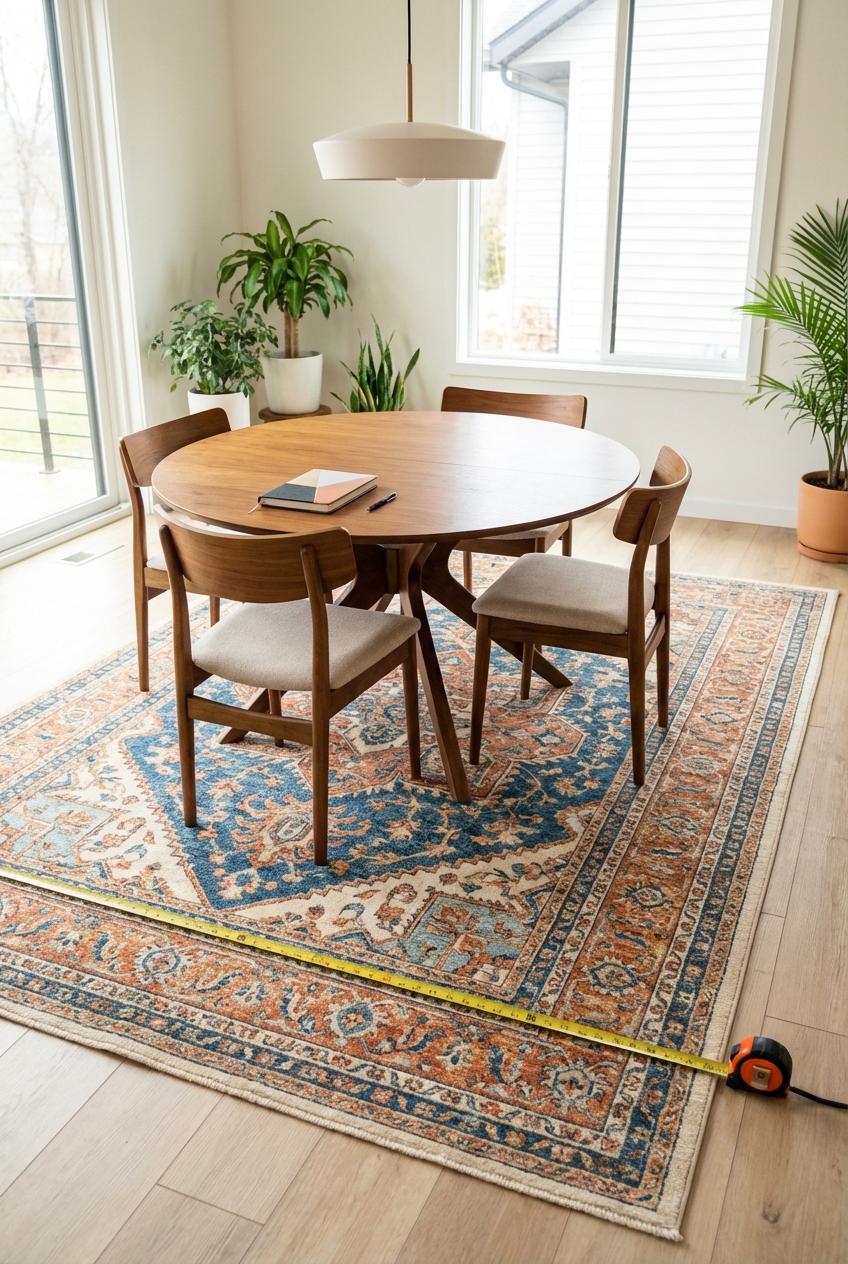
The rug should extend about 24 to 36 inches past every edge of the table. That way, all four legs of each chair stay on the rug when someone pulls out to stand up. To get your size, add 4 to 6 feet to the table's length and width.
That one rule covers most dining rooms. The rest of this post turns it into specific rug sizes for different tables, and flags the mistakes that make a rug catch chair legs or look lost under the furniture.
How big should a rug be under a dining table?
Size the rug to the chairs, not just the table. A chair pulled back to sit down or stand up moves roughly 18 to 24 inches from the table edge, and the person sitting in it needs a bit more. Allowing 24 to 36 inches of rug beyond the table gives the chairs room to travel without a back leg dropping off the edge.
If your table has a leaf, measure it fully extended. A rug that works for the everyday table but not for the holiday table is a rug that catches chairs at exactly the moment you have guests.
How do you measure for a dining room rug?
- Measure the table's length and width at its largest setting, leaf included.
- Add 48 to 72 inches to each dimension (24 to 36 inches per side).
- Check that the result leaves a border of bare floor in the room, ideally 12 to 18 inches or more along the walls.
- Mark the size on the floor with painter's tape, then pull a chair out and sit down. If a back leg lands on tape or beyond it, go bigger.
Tape is cheap and rugs aren't. Leave it down for a day or two and walk around it like you normally would.
Rug size by number of seats
Table sizes vary, so treat this as a starting point and run the math with your own measurements. Rugs are sold in standard sizes, so you'll usually round up to the next one.
| Seats | Typical table | Rug to look for |
|---|---|---|
| 4 | About 36 x 48 inches rectangular, or 36-42 inch round | 6x9 for a rectangle, 6x6 or 7x7 for a round |
| 6 | About 36 x 72 inches | 8x10 |
| 8 | About 40 x 96 inches | 9x12, or 8x11 if you can find it |
For a 72 inch table (6 feet), adding 4 to 6 feet to the length means a rug 10 to 12 feet long. In practice an 8x10 fits a 72 x 36 inch table with the minimum 24 inches on the short sides and a bit less on the long sides. If the room allows it, a 9x12 is more forgiving.
For the rug size for dining table for 4, you have more flexibility, because smaller tables sit comfortably on a 6x9. For the rug size for dining table for 8, a 9x12 is usually the smallest that works, and the room has to be big enough to hold it.

Will a 5x7 rug fit under a dining table?
Not in the way you want. A 5x7 rug is only 60 by 84 inches. Under even a small 36 x 48 inch table, that leaves about 12 inches on the short sides, so pulled-out chairs will have their back legs on bare floor and tip over the rug edge.
A 5x7 can work in one case: a very small round table, about 30 inches across, with chairs that sit close. Otherwise, use it somewhere else, such as a reading corner or under a bench in the entry.
What is the right rug size for a round dining table?
Start with the same 24 to 36 inches past the table edge, measured from the table's diameter. A 48-inch round table needs a rug at least 96 inches across, so an 8-foot round or square rug.
A round rug mirrors the table and keeps the lines soft. A square rug also works and fills the corners of a square dining room better. A rectangular rug under a round table tends to look off, because the table's center won't line up with the long axis of the rug.
Common mistakes: too small, too large, too thick
Too small
This is by far the most common one. Chairs catch on the edge, the rug curls, and the table looks like it's floating on a postage stamp. It's also a safety issue. A National Institutes of Health review of rug and carpet falls notes that loose throw rugs and area carpets with curled edges or folds are among the factors most often cited as unsafe and as potentially increasing fall risk. A rug that chairs keep dragging over is exactly that scenario.
Too large
If the rug runs into walls, doorways or a living area next to the dining space, it'll look squeezed in. Keep a margin of bare floor around it, and in open plans leave some floor between the dining rug and the living room rug so each zone reads as its own space.
Too thick
Chairs slide poorly across plush, high-pile rugs, and dropped food sinks into them. A low-pile or flatweave rug is easier on chairs and easier to clean. As an architect, I recommend a low pile for any dining room, and I'd go with wool or a washable synthetic if you have kids or a dog that hoovers up crumbs.
What material and pile work best under a dining table?
Dining rooms get spills, dragged chairs and daily foot traffic, so durability and cleanability matter more than softness.
- Wool: resilient, hides stains fairly well and handles chair traffic. Choose a flat or low cut pile. Skip loop piles if you have pets, since claws can snag them.
- Polypropylene or other synthetics: cheaper, easy to blot clean, and good for families with young children.
- Jute and sisal: durable but hard to clean, so I'd avoid them under a table where food ends up on the floor.
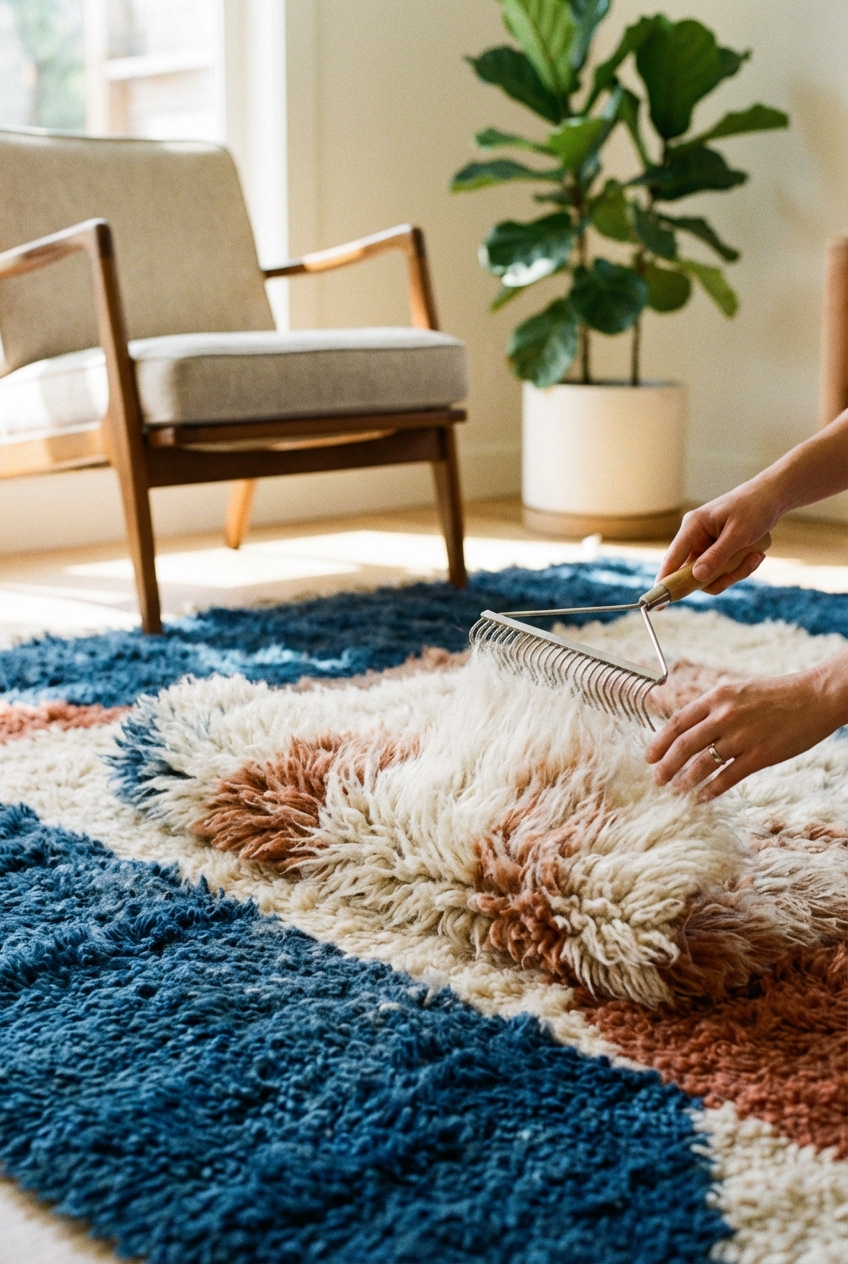
Add a rug pad cut about an inch smaller than the rug on every side. It keeps the rug from creeping when chairs scrape, and it protects the floor. If you want help with cleaning later, see how to clean a wool rug, and for homes with animals, there's a list of pet-friendly rug picks.
Open plans and layered rugs
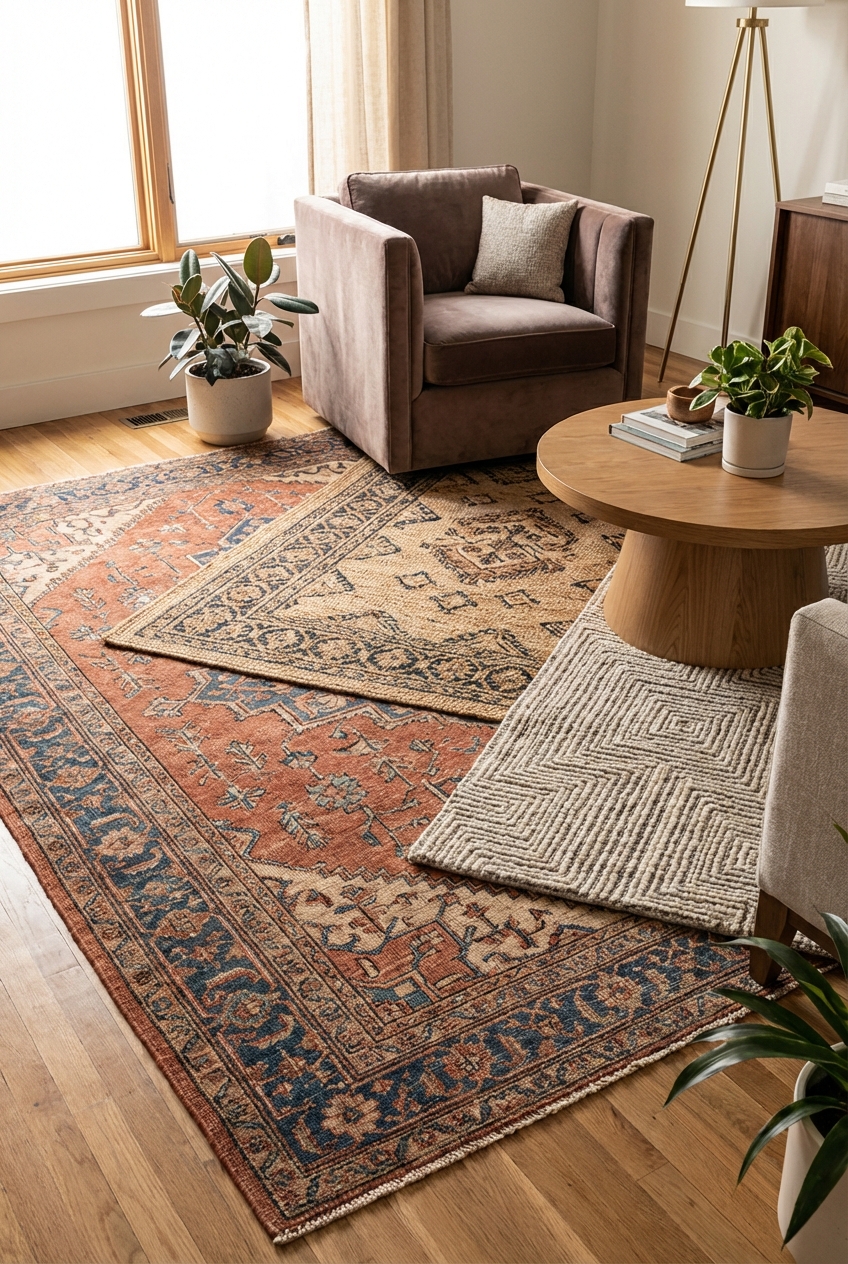
In an open-plan room, the dining rug defines the dining zone. Leave about 12 to 24 inches of floor between it and the living room rug so the two don't merge. If you're sizing the living area too, the guide on rug size for a living room with a sectional covers it, and layering rugs is an option when you want a larger base under a smaller, more decorative piece. For a deeper walkthrough of the measuring process, there's also how to measure rug size for a dining table.
One tip for layering under a dining table: keep the top rug large enough that chairs still stay fully on it. A small layered rug under the table brings back the same chair-catching problem.
Frequently asked questions
What size dining table for 8x10 rug?
An 8x10 rug suits a table about 36 x 72 inches, which seats six. That leaves about 24 inches of rug on each short side and a little less on the long sides, so size up to a 9x12 if the room allows it.
What size rug for a 72 inch rectangular dining table?
An 8x10 is the minimum that works, and a 9x12 is more comfortable. Add 48 to 72 inches to the table length, which points to a rug about 10 to 12 feet long ideally.
Should the rug go under all the chair legs?
Yes. Every chair leg should stay on the rug when the chair is pulled out, because a back leg dropping off the edge is what makes chairs tip and rug edges curl.
Is it okay to use a round rug under a rectangular table?
It can work if the round rug is big enough that chairs stay on it when pulled out, but the corners of the table will usually stick out and look unbalanced. A rectangular or oval rug usually fits better.
Filed under
ArticlesMeet the author
Written by an architect.
Julio Arco is a passionate architect with years of experience in architecture, interior design, urban design, and housing. He studied at prestigious universities across North America and Europe.

- Name
- Julio Arco
- Job
- Architect and online interior designer
- Studied
- Architecture, ITESM · Urban Design and Housing, McGill
- Partner
- Thor, Australian Shepherd
- Thor’s title
- Head of quality control